DEREPLICATION OF ISOQUINOLINE ALKALOIDS FROM Duguetia Quitarensis (benth.) AND EVALUATION OF PHYTOTOXIC ACTIVITY
Keywords:
Duguetia quitarensis, Annonaceae, alkaloids, dereplication, phytotoxic activity.Abstract
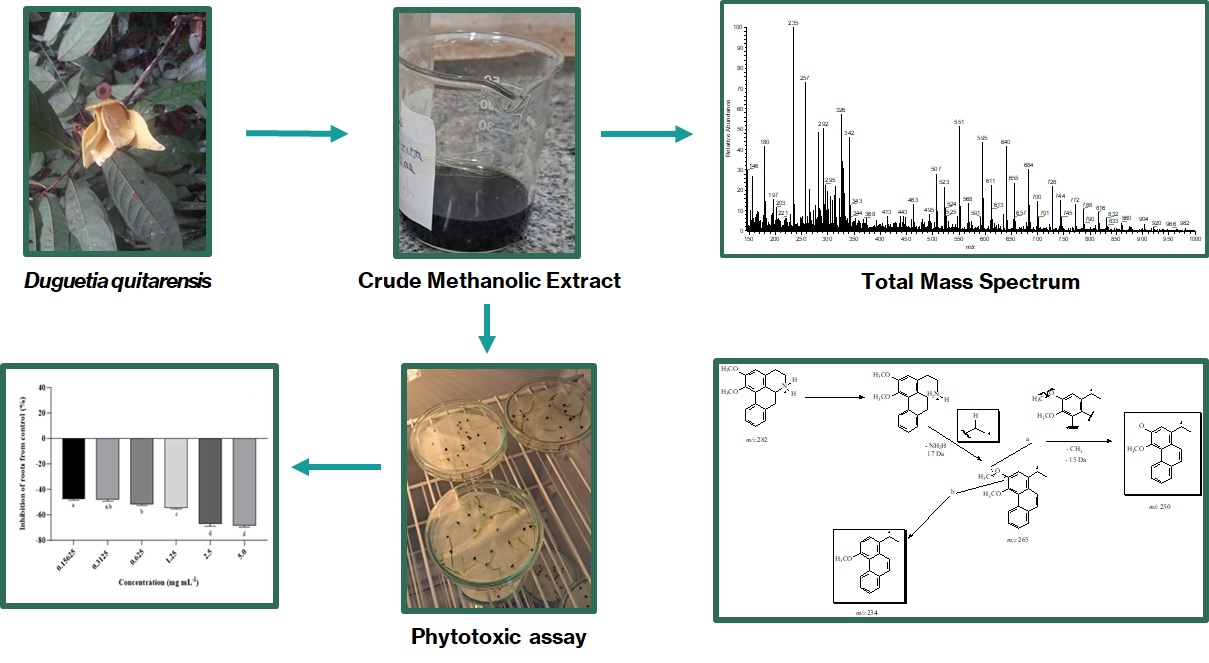
Duguetia quitarensis (Benth.) is a species distributed across the Amazon region, from Venezuela to Bolivia. This study aimed to characterize the chemical profile of the methanolic extract of D. quitarensis through dereplication by direct infusion and to evaluate its phytotoxic potential against Allium cepa L. and Lactuca sativa L. Ten isoquinoline alkaloids were annotated, including aporphine-, benzyl-tetrahydroisoquinoline-, 7-hydroxyaporphine-, and oxoaporphine-type compounds. The methanolic extract exhibited phytotoxic effects of varying intensity, as indicated by seedling growth inhibition and germination assays. Root elongation was more sensitive than hypocotyl growth, particularly in A. cepa. The presence of multiple isoquinoline alkaloids suggests their contribution to the observed phytotoxicity, possibly through interference in cellular processes such as respiration and DNA synthesis. These findings expand the chemical knowledge of D.quitarensis and indicate its potential as a natural source of allelopathic or bioherbicidal compounds.
References
PIRES, N. M.; OLIVEIRA, V. R. “Alelopatia”. Em: OLIVEIRA, R. S et al. (eds.). Biologia e Manejo de Plantas Daninhas. Omnipax, Curitiba, 2011, Cap.5. pp 95-124. Alelopatia. ISBN 978-85-64619-02-9. Disponível: https://www.alice.cnptia.embrapa.br/alice/handle/doc/910833
DE SOUZA, C. S. M. et al. “Alelopatia do extrato aquoso de folhas de aroeira na germinação de sementes de alface”. Rev. Verde Agroecologia e Desenvolv. Sustent. 2007, 2, 96-100. https://doi.org/10.1590/1983-084X/14_160
BALBINOT JUNIOR, A. A.. Manejo das plantas daninhas pela alelopatia. Agropecuária Catarinense, 2011. 17(1), 61-64. Recuperado de https://publicacoes.epagri.sc.gov.br/rac/article/view/994. ISSN: 2525-6076.
DE OLIVEIRA, A. K. M.; MATIAS, R.; PINA, J.C.; DA SILVA, L. T. “Alelopatia e seu potencial na formulação de bioherbicidas”. Em: GUIDOLIN, D. G. F.; BARBOSA-FERREIRA, M.; PEREIRA, S. H. (Eds.). Produção e gestão agroindustrial. Editora Científica, Londrina, 2017, pp 90-104. ISBN: 978-65-00-11649-6. Disponível em: https://repositorio.pgsscogna.com.br/bitstream/123456789/29667/1/Coletana%20-
%20Produ%C3%A7%C3%A3o%20e%20Gest%C3%A3o%202017.pdf . Acesso em: 21 Set. 2025.
DA SILVA, M. A. D. et al. “Alelopatia de espécies da Caatinga”. Research Society and Development. 2021, 10, e57610414328 e57610414328. DOI: https://doi.org/10.33448/rsd-v10i4.14328. ISSN:2525-3409.
CASCAES, M. M. et al. “Essential Oils fromAnnonaceae Species from Brazil: A Systematic Review of Their Phytochemistry, and Biological
Activities”. International Journal of Molecular Sciences. 2021, 22(22), 12140. DOI: https://doi.org/10.3390/ijms222212140. ISSN: 1422-0067.
BAY, M. et al. “Atividades antioxidante e antibacteriana in vitro de extratos vegetais da família Annonaceae”. South American Journal of Basic Education Techinical. and Technological. 2020, 7, 128-144. ISSN: 2446-4821. https://teste-periodicos.ufac.br/index.php/SAJEBTT/article/download/3661/2488
MOGHADAMTOUSI, S. Z. et al. “Annona muricata (Annonaceae): A review of its traditional uses, isolated acetogenins and biological activities”. International Journal of Molecular Sciences. 2015,16, 15625-15658. DOI: https://doi.org/10.3390/ijms160715625
CARNEVALE NETO, F. Elaboração de métodos analíticos de derreplicação para o estudo metabolômico de especies de Quela (Vochysiaceae): detecção e elucidação in situ de micromoléculas com potencial antioxidante e antimalárico Dissertação de Mestrado em Química, Instituto de Química, Universidade Estadual Paulista, UNESP, Araraquara, 2020, 104 pp. http://hdl.handle.net/11449/97891
MACÍAS, F. A.; CASTELLANO, D.; MOLINILLO, J. M. G. “Search for a standard phytotoxic bioassay for allelochemicals. Selection of
standard target species”. Journal of Agricultural and Food Chemistry. 2000, 48, 2512-2521. DOI: https://doi.org/10.1021/jf9903051
PINTO, G. F. S.; ROMA, L. P.; KOLB, R. M. “Phytotoxicity of organic extracts of five medicinal plants of the Neotropical savanna”. Brazilian Journal of Biology. 2023, 83, e270122. DOI: https://doi.org/10.1590/1519-6984.270122
OLIVEIRA, S. C. C. et al. “Estudo fitoquímico de Solanum lycocarpum A. St.-Hil (Solanaceae) e sua aplicação na alelopatia”. Acta Botanica Brasilica. 2012, 26, 607-618. DOI: https://doi.org/10.1590/S0102-33062012000300010
BARBOSA, W. L. R. et al. “Manual para análise fitoquímica e cromatográfica de extratos vegetais”. Revista Científica da UFPA, 2004, 4, 1-19. ISSN:2179-7536.
DOS SANTOS, A. R.; VAZ, N. P. “Isoquinoline alkaloids and chemotaxonomy”. In: Ramawat, K. (Eds.). Biodiversity and Chemotaxonomy. Sustainable Development and Biodiversity, Springer Cham., Switzerland. 2019, pp 167-193.
DOI: https://doi.org/10.1007/978-3-030-30746-2_8
SHIM, H. J. et al. “General fragmentations of alkaloids in electrospray ionization tandem mass spectrometry”. Mass Spectrometry Letters. 2013, 4,79-82. DOI: https://doi.org/10.5478/MSL.2013.4.4.79
DE LIMA, B. R. et al. “Integrative approach based on leaf spray mass spectrometry, HPLC-DAD-MS/MS, and NMR for comprehensive
characterization of isoquinoline-derived alkaloids in leaves of Onychopetalum amazonicum R.E.Fr”. Journal of the Brazilian Chemical Society. 2020, 31, 79-89. DOI: http://dx.doi.org/10.21577/0103-5053.20190125
WANG, Z. et al. “Lotus (Nelumbo nucifera Gaertn.) leaf: A narrative review of its phytoconstituents, health benefits and food industry
applications”. Trends in Food Science & Technology. 2021, 112, 631-650. DOI: https://doi.org/10.1016/j.tifs.2021.04.033
CONCEIÇÃO, R. S. et al. “Rapid structural characterization of benzylisoquinoline and aporphine alkaloids from Ocotea spixiana acaricide extract by HPTLC-DESI-MSn”. Phytochemical Analysis. 2020,31, 711-721. DOI: https://doi.org/10.1002/pca.2935
MARQUES, J. V. et al. “A multi-omics strategy resolves the elusive nature of alkaloids in Podophyllum species”. Molecular BioSystems. 2013,10, 2838-2849. DOI: https://doi.org/10.1039/C4MB00403E
YAN, R. et al. “Studies on the alkaloids of the bark of Magnolia officinalis: Isolation and on-line analysis HPLC-ESI-MSn”. Molecules. 2013, 18, 7739-7750. DOI: https://doi.org/10.3390/molecules18077739
BARAKAT, S. A.; FERAS, Q. A.; AL HAMMOURI, M. A. “Dereplication study on Glaucium aleppicum Boiss. In Jordan”. Oriental Journal of Chemistry. 2016, 32, 1815-1822. DOI:http://dx.doi.org/10.13005/ojc/320409
SCHMIDT, J. et al. “Analysis of benzylisoquinoline-type alkaloids by electrospray tamdem mass spectrometry and atmospheric pressure photoionization”. European Journal of Mass Spectrometry. 2005, 11, 325-333. DOI: https://doi.org/10.1255/ejms.745
DE SOUZA, C. A. S. et al. “Asarone-derived phenylpropanoids and isoquinoline-derived alkaloids from the bark of Duguetia pycnastera (Annonaceae) and their cytotoxicities”. Quimica. Nova. 2020, 43, 1397-1403. DOI: http://dx.doi.org/10.21577/0100-4042.20170617
DA SILVA, F. M. A. et al. “Positive electrospray ionization ion trap mass spectrometry and ab initio computational studies of the
multi-pathway fragmentation of oxoaporphine alkaloids”. International Journal of Mass Spectrometry. 2017,
, 30-36. DOI: https://doi.org/10.1016/j.ijms.2016.12.004
FERREIRA, A. G.; AQUILA, M. E. A. “Alelopatia: uma área emergente da ecofisiologia”. Revista Brasileira de Fisiologia Vegetal. 2000, 12,
-204. v12 (Especial) p175.PDF. ISSN: 0103-3131
HAIG, T. “Allelochemicals in Plants”. In: Zeng, R.S., Mallik, A.U., Luo, S.M. (eds.). Allelopathy in Sustainable Agriculture and Forestry. Springer, New York, NY. 2008. DOI: https://doi.org/10.1007/978-0-387-77337-7_4
Downloads
Published
How to Cite
Issue
Section
License
Copyright (c) 2025 Márcia Bay, Vitória C. da-Silva-Nery, Hugo Rodrigues-da-Silva, Anderson Rogério-dos-Santos

This work is licensed under a Creative Commons Attribution-NonCommercial-NoDerivatives 4.0 International License.
This journal provides immediate open access to its content, based on the principle that offering the public free access to research helps a greater global exchange of knowledge. Each author is responsible for the content of each of their articles.