EVALUATION OF LECISAN® AS A POTENTIAL SOURCE OF NATURAL ANTIOXIDANTS FOR THE FOOD INDUSTRY
Keywords:
LECISAN®; antioxidant activity; nutritional supplement; soy lecithin.Abstract
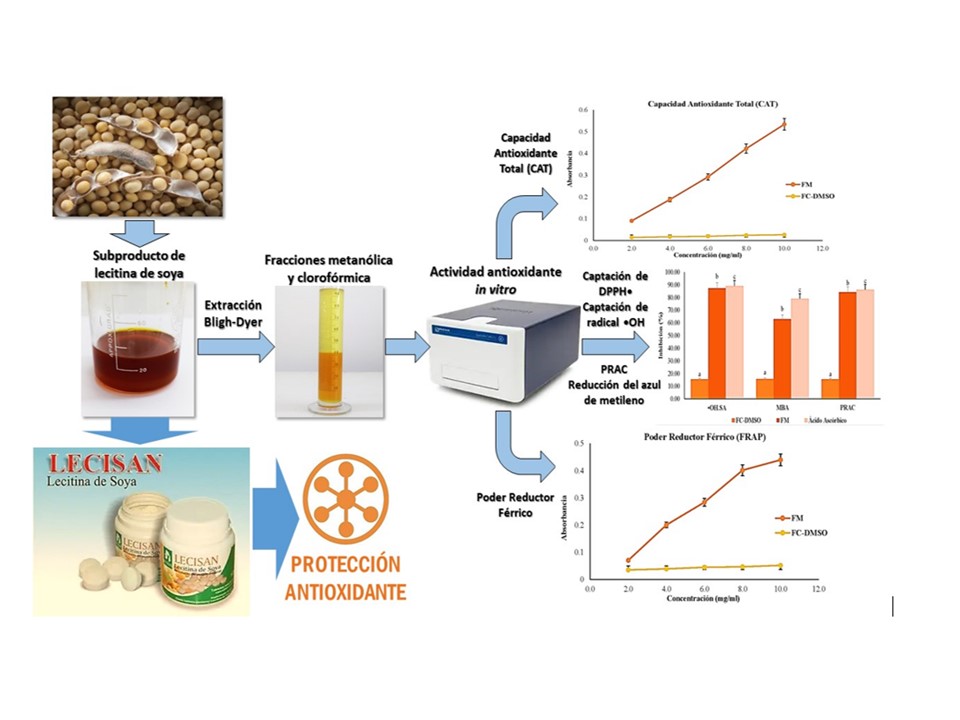
Innovation in the food industry has led to the discovery of new sources of natural antioxidants, capable of improving the quality and extending the shelf life of foods. This research evaluated the antioxidant potential of soy lecithin used in the formulation of LECISAN® to enhance knowledge about its benefits and applications in the food industry. An in vitro analytical study was conducted through different assays: total antioxidant capacity (TAC), ferric reducing power (FRAP), permanganate reducing antioxidant capacity (PRAC), methylene blue reduction assay (MBA), hydroxyl radical scavenging (•OHSA), and DPPH (2,2-diphenyl-1-picrylhydrazyl) radical inhibition assay. The results demonstrated antioxidant properties in the soy lecithin by-product
that add significant value to the nutritional supplement LECISAN®, supporting the feasibility of using this by-product as a natural source of antioxidants.
References
BELTRÁN, Y. et al. “Composición de fenoles y
propiedades antioxidantes de la seta Pleurotus
ostreatus. Aplicación en alimentos funcionales”.
Anales de la Academia de Ciencias de Cuba. 2024,
(4), e1657.
http://www.revistaccuba.cu/index.php/revacc/article/v
iew/1657
BENÍTEZ-ESTRADA, A. et al. “Determinación de
la capacidad antioxidante total de alimentos y plasma
humano por fotoluminiscencia: Correlación con
ensayos fluorométricos (ORAC) y
espectrofotométricos (FRAP)”. TIP. 2020, 23,
e20200244.
https://doi.org/10.22201/fesz.23958723e.2020.0.244
CALA-CALVIÑO, L. et al. “Caracterización
química del LECISAN®, contribución al estudio del
producto natural.” Revista de Información Científica.
, 103, e4360.
https://doi.org/10.5281/zenodo.10456644
CALA, L. et al. “Efectos de la lecitina de soya
sobre parámetros antropométricos en ratas Wistar”.
Revista Cubana de Farmacia. 2021, 54(4), e605.
https://revfarmacia.sld.cu/index.php/far/article/downlo
ad/605/444
PINO, J. A. “Lecitina: química, bioquímica y uso
en la industria alimentaria”. Ciencia y Tecnología de
Alimentos. 2021, 31(1), 68-77. ISSN 1816-7721.
CUI, L.; DECKER, E. A. “Phospholipids in foods:
prooxidants or antioxidants?”. Journal of the Science
of Food and Agriculture. 2016, 96(1), 18-31.
https://doi.org/10.1002/jsfa.7320
ZHAO, Q. et al. “Impact of phosphatidylcholine
and phosphatidylethanolamine on the oxidative
stability of stripped peanut oil and bulk peanut oil”.
Food Chemistry. 2020, 311, 125962.
https://doi.org/10.1016/j.foodchem.2019.125962
BLIGH, E. G.; DYER, W. J. “A rapid method of
total lipid extraction and purification”. Canadian
Journal of Biochemistry and Physiology. 1959, 37(8),
-917. https://doi.org/10.1139/o59-099
ELSHERIF, K. M. et al. “Phytochemical screening,
antioxidant capacity measurement, and mineral
content determination of Thymus vulgaris L.
extracts”. Walisongo Journal of Chemistry. 2023,
(2), 168-180.
https://doi.org/10.14421/biomedich.2023.121.17-23
DIB, M.; BENBOTT, A. “FTIR analysis and
study of some physicochemical parameters and
antioxidant activity of Opuntia ficus indica seed oil
from Tebessa region, Algeria”. Notulae Scientia
Biologicae. 2023, 5(1), 1-15.
https://doi.org/10.15835/nsb15111345
MOHAMED, H. R. et al. “Evaluation of total
phenolics, flavonoids, and antioxidant and cytotoxic
potential of Ailanthus altissima (Mill.) Swingle
leaves”. Journal of Reports in Pharmaceutical
Sciences. 2021, 10(1), 130-136.
https://doi.org/10.4103/jrptps.JRPTPS_7_21
GABER, N. B.; EL-DAHY, S. I.; SHALABY, E.
A. “Comparison of ABTS, DPPH, permanganate, and
methylene blue assays for determining antioxidant
potential of successive extracts from pomegranate and
guava residues”. Biomass Conversion and
Biorefinery. 2021, 13(5), 4011-4020.
https://doi.org/10.1007/s13399-021-01386-0
VELASCO, J. et al. “New insights into the loss of
antioxidant effectiveness of phenolic compounds in
vegetable oils in the presence of
phosphatidylcholine”. Antioxidants. 2023, 12(11),
https://doi.org/10.3390/antiox12111993
NILE, S. H. et al. “Soybean processing wastes:
Novel insights on their production, extraction of
isoflavones, and their therapeutic properties”. Journal
of Agricultural and Food Chemistry . 2022, 70(23),
-6863. https://doi.org/10.1021/acs.jafc.1c04927
SHALABY, E. A.; SHANAB, S. M. M.
“Comparison of DPPH and ABTS assays for
determining antioxidant potential of water and
methanol extracts of Spirulina platensis”. Indian
Journal of Geo-Marine Sciences. 2013, 42(5), 556
https://nopr.niscpr.res.in/bitstream/123456789/24794/
/IJMS%2042(5)%20556-564.pdf
NASAB, M. E., et al. “In vitro antioxidant activity
and in vivo wound-healing effect of lecithin
liposomes: a comparative study.” Journal of
Comparative Effectiveness Research. 2019, 8(8), 633
https://doi.org/10.2217/cer-2018-0128
FERNÁNDEZ-VENTOSO, L. et al.
“Distributions of α- and δ-tocopherol in intact olive and soybean oil-in-water emulsions at various
acidities: A test of sensitivity of the pseudophase
kinetic model”. Antioxidants. 2022, 11(12), 2477.
https://doi.org/10.3390/antiox11122477
PICCOLI, M. et al. “Sphingolipids and
Atherosclerosis: The Dual Role of Ceramide and
Sphingosine-1-Phosphate”. Antioxidants. 2023, 12(1),
https://doi.org/10.3390/antiox12010143
GIULIA-COLIVA, L.M. et al. “Sphingomyelins
Prevent Propagation of Lipid Peroxidation-LC
MS/MS Evaluation of Inhibition Mechanisms.”
Molecules.
,
(8),
-1925.
https://doi.org/10.3390/molecules25081925
DINI, I.; GRUMETTO, L. “Recent Advances in
Natural Polyphenol Research”. Molecules. 2022,
(24), 8777. https://doi.org/10.3390/molecules27248777
DIAS, M. C.; PINTO, D. C. G. A.; SILVA, A. M.
S. “Plant Flavonoids: Chemical Characteristics and Biological Activity”. Molecules. 2021, 26(17), 5377. https://doi.org/10.3390/molecules26175377
YUAN, X. “Evaluation on antioxidant activities of
the soybean oils and gums”. Tesis defendida en
opción al Grado de Master. Louisiana State
University, United States of America, 2006.
https://doi.org/10.31390/gradschool_theses.3941
SÁNCHEZ-BRAGAGNOLO, F. et al.
“Pressurized natural deep eutectic solvents: An
alternative approach to agro-soy by-products”.
Frontiers in Nutrition. 2022, 9, 953169. https://doi.org/10.3389/fnut.2022.953169
HARSHIKA, A. et al. “Production of a high
phosphatidylserine lecithin that synergistically
inhibits lipid oxidation with α-tocopherol in oil-in
water emulsions”. Foods. 2022, 11(7), 1014.
Downloads
Published
How to Cite
Issue
Section
License
Copyright (c) 2025 David Garrido-Larramendi, , Yuleidis González-Pérez, Humberto J. Morris-Quevedo , Leidys Cala-Calviño

This work is licensed under a Creative Commons Attribution-NonCommercial-NoDerivatives 4.0 International License.
This journal provides immediate open access to its content, based on the principle that offering the public free access to research helps a greater global exchange of knowledge. Each author is responsible for the content of each of their articles.