
ELECTROSPUN CHITOSAN/POLYVINYL ALCOHOL CEFUROXIME MEMBRANES, WITH POTENTIAL USE AS AN ANTIMICROBIAL DRESSING
Keywords:
electrospinning, chitosan, poly(vinyl alcohol), drug delivery, antibacterial activityAbstract
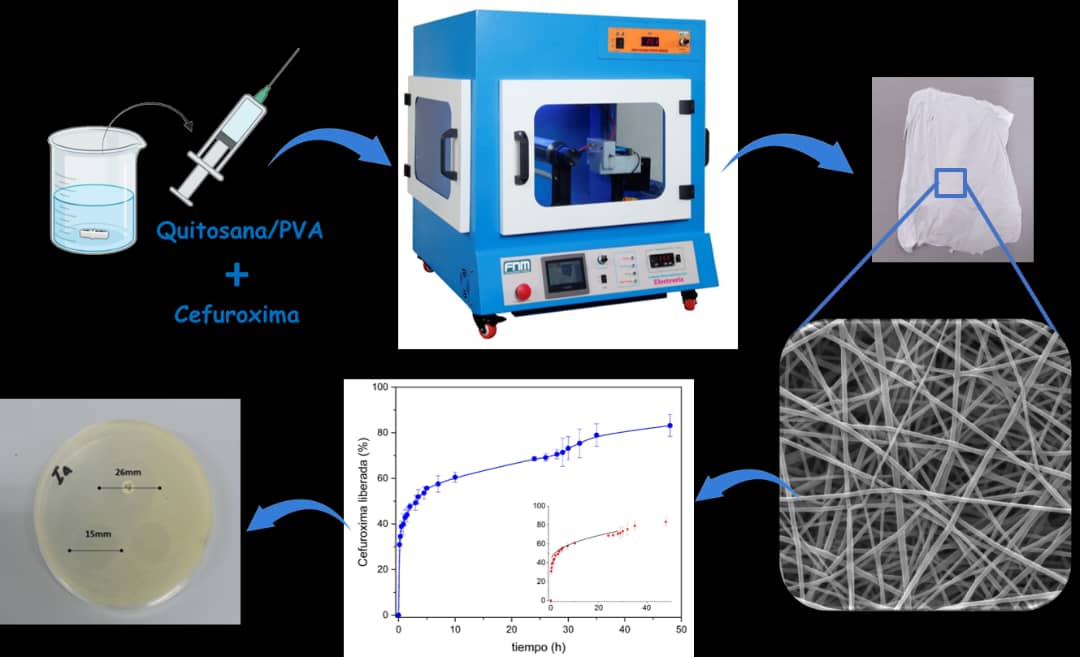
Electrospun chitosan and polyvinyl alcohol (QS/PVA) nanofibers have gained noticeability in biomedicine, but their loading with cefuroxime (CFX) had not been previously explored. This work introduces the novel preparation of CFX-loaded QS/PVA nanofibers and evaluates their properties. The membranes exhibited mostly homogeneous nanofibrous structures, as confirmed by Scanning Electron Microscopy (SEM). The micrographs guided the establishment of optimal working conditions, specifically a QS/PVA ratio of 25:75 and a 0,64 mm needle diameter to optimize morphology. Infrared spectroscopy revealed possible interactions between the drug and the matrix, suggesting an affinity between both components. The release study showed an initial rapid burst of the drug followed by a more sustained release over time. In antibacterial tests, the loaded nanofibers showed good inhibitory activity against E. coli. Overall, the CFX-loaded QS/PVA membranes demonstrated high potential as wound dressings.
References
Al Programa Nacional de Nanociencias y Nanotecnologías PN3 y al Proyecto PN211LH008-019 titulado: “Implementación, caracterización y validación de técnicas para la obtención de nanomateriales con aplicaciones en la ingeniería de tejidos y la industria farmacéutica”.
REFERENCIAS BIBLIOGRÁFICAS
KUMARI, A. et al. "Wound-Healing Effects of Curcumin and Its Nanoformulations: A Comprehensive Review", Pharmaceutics. 2022. 14(11), 2288. DOI: https://doi.org/10.3390/pharmaceutics14112288
SHAH, S. A. et al. "Biopolymer-based biomaterials for accelerated diabetic wound healing: A critical review". International Journal of Biological Macromolecules. 2019. 139, 975-993. DOI: https://doi.org/10.1016/j.ijbiomac.2019.08.007
YADAV, P. D. et al. "Electrospun composite nanofibers for wound healing: synthesis, characterization, and clinical potential of biopolymer-based materials". Discover Materials. 2024. 4(1), 99. DOI: https://doi.org/10.1007/s43939-024-00173-8
TAVAKOLI, M. et al. "Asymmetric tri-layer sponge-nanofiber wound dressing containing insulin-like growth factor-1 and multi-walled carbon nanotubes for acceleration of full-thickness wound healing". Biomaterials Advances. 2023. 151, 213468. DOI: https://doi.org/10.1016/j.bioadv.2023.213468
JUNG, J. W. et al. "Electrospun nanofibers as a platform for advanced secondary batteries: a comprehensive review". Journal of Materials Chemistry A. 2016. 4(3), 703-750. DOI: https://doi.org/10.1039/C5TA06844D
IACOB, A. T. et al. "An Overview of Biopolymeric Electrospun Nanofibers Based on Polysaccharides for Wound Healing Management". Pharmaceutics . 2020. 12(10), 983. DOI: https://doi.org/10.3390/pharmaceutics12100983
TAMILARASI, G. P. et al. "Advances in electrospun chitosan nanofiber biomaterials for biomedical applications". Materials Advances. 2023. 4(15), p. 3114-3139. DOI:
https://doi.org/10.1039/D3MA00010A
SALLEH, N. A. M. et al. "Enhancing mechanical properties of chitosan/PVA electrospun nanofibers: a comprehensive review". Beilstein Journal of Nanotechnology. 2025. 16, p. 286-307. DOI: https://doi.org/10.3762/bjnano.16.22
YANG, S.; ZHANG, X.; ZHANG, D. "Electrospun Chitosan/Poly (Vinyl Alcohol)/Graphene Oxide Nanofibrous Membrane with Ciprofloxacin Antibiotic Drug for Potential Wound Dressing Application". International Journal of Molecular Sciences. 2019. 20(18), p. 4395. DOI: https://doi.org/10.3390/ijms20184395
AUGUSTINE, R. et al. "Electrospun chitosan membranes containing bioactive and therapeutic agents for enhanced wound healing". International Journal of Biological Macromolecules 2020. 156, p. 153-170. DOI: https://doi.org/10.1016/j.ijbiomac.2020.03.207
ARIAS-ANDRADE, Y. V.; VELOZA, L. A.; SEPÚLVEDA-ARIAS, J. C. "Nanocompuestos de Quitosano Aplicados al Campo de la Medicina Regenerativa. Una Revisión Sistemática". Scientia et Technica 2020. 25, p. 604-615. DOI: https://doi.org/10.22517/23447214.23411
DORNISH, M.; KAPLAN, D.; SKAUGRUD, Ø. "Standards and Guidelines for Biopolymers in Tissue-Engineered Medical Products". Annals of the New York Academy of Sciences. 2001. 944(1), p. 388-397. DOI: https://doi.org/10.1111/j.1749-6632.2001.tb03850.x
KAMOUN, E. A. et al. "Recent advances in PVA-polysaccharide based hydrogels and electrospun nanofibers in biomedical applications: A review". International Journal of Biological Macromolecules. 2021. 187, p. 755-768. DOI: https://doi.org/10.1016/j.ijbiomac.2021.08.002
ALOTAIBI, B. S. et al. "Development of Poly(vinyl alcohol)-Chitosan Composite Nanofibers for Dual Drug Therapy of Wounds". ACS Omega. 2024. 9(11), p. 12825-12834. DOI: https://doi.org/10.1021/acsomega.3c08856
PAWAR, V.; DHANKA, M.; SRIVASTAVA, R. "Cefuroxime conjugated chitosan hydrogel for treatment of wound infections". Colloids and Surfaces B: Biointerfaces. 2019. 173, p. 776-787. DOI: https://doi.org/10.1016/j.colsurfb.2018.10.034
KORSMEYER, R. W. et al. "Mechanisms of solute release from porous hydrophilic polymers". International Journal of Pharmaceutics. 1983. 15(1), p. 25-35. DOI: https://doi.org/10.1016/0378-5173(83)90064-9
LINDNER, W. D.; LIPPOLD, B. C. "Drug Release From Hydrocolloid Embeddings with High or Low Susceptibility to Hydrodynamic Stress". Pharmaceutical Research. 1995. 12(11),
p. 1781-1785. DOI: https://doi.org/10.1023/A:1016238427313
PEPPAS, N. A.; SAHLIN, J. J. "A simple equation for the description of solute release. III. Coupling of diffusion and relaxation". International Journal of Pharmaceutics. 1989. 57(2),
p. 169-172. DOI: https://doi.org/10.1016/0378-5173(89)90306-2
LEWIS, J. S. I.; CLSI M100. Performance Standards for Antimicrobial Susceptibility Testing. 33rd Edition. USA: Clinical and Laboratory Standards Institute, Wayne, PA., 2023. ISBN: 978-1-68440-171-0.
SEDGHI, R. et al. "Biocompatible electrospinning chitosan nanofibers: A novel delivery system with superior local cancer therapy". Carbohydrate Polymer. 2017. 159,
p. 1-10. DOI: https://doi.org/10.1016/j.carbpol.2016.12.011
LI, L.; HSIEH, Y. L. "Chitosan bicomponent nanofibers and nanoporous fibers". Carbohydrate Research. 2006. 341(3), p. 374-381. DOI: https://doi.org/10.1016/j.carres.2005.11.028
OLVERA BERNAL, R. A.; OLEKHNOVICH, R. O.; USPENSKAYA, M. V. "Chitosan/PVA Nanofibers as Potential Material for the Development of Soft Actuators". Polymers. 2023. 15(9), p. 2037. DOI: https://doi.org/10.3390/polym15092037
ABUNAHEL, B. M.; AZMAN, N. Z. N.; JAMIL, M. "Effect of Needle Diameter on the Morphological Structure of Electrospun n-Bi2O3 /Epoxy-PVA Nanofiber Mats". International Journal of Chemical and Materials Engineering. 2018. 12(6), p. 296-299. https://scholar.waset.org/1307-6892/10009361
CHENG, F. et al. "Composite chitosan/poly(ethylene oxide) electrospun nanofibrous mats as novel wound dressing matrixes for the controlled release of drugs". Journal of Applied Polymer Science. 2015. 132(24). DOI: https://doi.org/10.1002/app.42060
AL-ABDULJABBAR, A.; FAROOQ, I. "Electrospun Polymer Nanofibers: Processing, Properties, and Applications". Polymers. 2023. 15(1), p. 65. DOI: https://doi.org/10.3390/polym15010065
CRUZ-SEGUNDO, C. M. et al. "Development and characterization of electrospun chitosan-chitin-PVA nanofiber: exploring structural integrity, crystallinity, and thermal stability for advanced applications". Journal of Materials Science: Materials in Engineering. 2025. 20(1), p. 103. DOI: https://doi.org/10.1186/s40712-025-00318-4
ASIRI, A. et al. "Effects of Electrospinning Voltage and Flow Rate on Morphology of Poly-vinyl Alcohol Nanofibers". Journal of Physics: Conference Series. 2019. 1372(1), p. 012035. DOI: https://doi.org/10.1088/1742-6596/1372/1/012035
FAÍSCA, F. et al. "Synthesis, Characterization, Bioavailability and Antimicrobial Studies of Cefuroxime-Based Organic Salts and Ionic Liquids". Pharmaceutics. 2024. 16(10), p. 1291. DOI: https://doi.org/10.3390/pharmaceutics16101291
SAKTHI VELU, K. et al. "Flufenamic Acid-Loaded Electrospun Nanofibers Based on Chitosan/Poly(vinyl alcohol) Polymeric Composites for Drug Delivery in Biomedical Applications". Polymers. 2025. 17(10), p. 1411. DOI: https://doi.org/10.3390/polym17101411
Downloads
Published
How to Cite
Issue
Section
License
Copyright (c) 2025 Sheyla Bermudez-Pérez, Jorge L. Borrego-Díaz, Jomarien García-Couce, Ahmed Valdés-Martínez, Eduardo Peón-Avés

This work is licensed under a Creative Commons Attribution-NonCommercial-NoDerivatives 4.0 International License.
This journal provides immediate open access to its content, based on the principle that offering the public free access to research helps a greater global exchange of knowledge. Each author is responsible for the content of each of their articles.