
MEMBRANAS DE QUITOSANA/ALCOHOL POLIVINÍLICO CEFUROXIMA OBTENIDAS MEDIANTE ELECTROHILADO, CON POTENCIAL USO COMO APÓSITO ANTIMICROBIANO
Palabras clave:
electrohilado, quitosana, alcohol polivinílico, liberación controlada, actividad antimicrobianaResumen
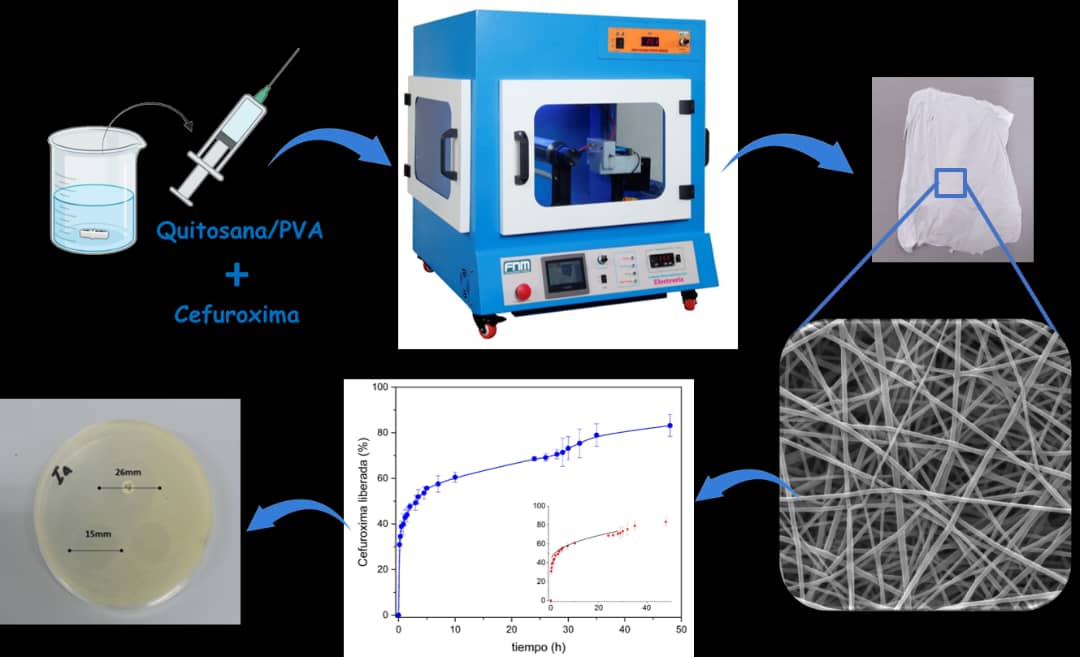
Las nanofibras electrohiladas de quitosana y alcohol polivinílico (QS/PVA) han ganado relevancia en biomedicina, pero su carga con cefuroxima (CFX) no ha sido explorada. Este trabajo propone como novedad la obtención de nanofibras QS/PVA cargadas con CFX, y la evaluación de sus propiedades. Las membranas exhibieron estructuras nanofibrosas, mayormente homogéneas corroboradas por Microscopía Electrónica de Barrido (SEM). Las micrografías permitieron fijar condiciones de trabajo: relación de QS/PVA de 25:75 y diámetro de aguja de 0,64 mm, optimizando la morfología. Por espectroscopía infrarroja se observaron posibles interacciones entre el fármaco y la matriz, sugiriendo afinidad entre ambos componentes. El estudio de liberación, mostró una salida inicial rápida del fármaco, seguida de una liberación más estable a lo largo del tiempo. En las pruebas antibacterianas, las nanofibras cargadas mostraron buena actividad inhibitoria contra E. coli. En conjunto, las membranas QS/PVA cargadas con CFX presentaron un alto potencial como apósitos para heridas.
Citas
Al Programa Nacional de Nanociencias y Nanotecnologías PN3 y al Proyecto PN211LH008-019 titulado: “Implementación, caracterización y validación de técnicas para la obtención de nanomateriales con aplicaciones en la ingeniería de tejidos y la industria farmacéutica”.
REFERENCIAS BIBLIOGRÁFICAS
KUMARI, A. et al. "Wound-Healing Effects of Curcumin and Its Nanoformulations: A Comprehensive Review", Pharmaceutics. 2022. 14(11), 2288. DOI: https://doi.org/10.3390/pharmaceutics14112288
SHAH, S. A. et al. "Biopolymer-based biomaterials for accelerated diabetic wound healing: A critical review". International Journal of Biological Macromolecules. 2019. 139, 975-993. DOI: https://doi.org/10.1016/j.ijbiomac.2019.08.007
YADAV, P. D. et al. "Electrospun composite nanofibers for wound healing: synthesis, characterization, and clinical potential of biopolymer-based materials". Discover Materials. 2024. 4(1), 99. DOI: https://doi.org/10.1007/s43939-024-00173-8
TAVAKOLI, M. et al. "Asymmetric tri-layer sponge-nanofiber wound dressing containing insulin-like growth factor-1 and multi-walled carbon nanotubes for acceleration of full-thickness wound healing". Biomaterials Advances. 2023. 151, 213468. DOI: https://doi.org/10.1016/j.bioadv.2023.213468
JUNG, J. W. et al. "Electrospun nanofibers as a platform for advanced secondary batteries: a comprehensive review". Journal of Materials Chemistry A. 2016. 4(3), 703-750. DOI: https://doi.org/10.1039/C5TA06844D
IACOB, A. T. et al. "An Overview of Biopolymeric Electrospun Nanofibers Based on Polysaccharides for Wound Healing Management". Pharmaceutics . 2020. 12(10), 983. DOI: https://doi.org/10.3390/pharmaceutics12100983
TAMILARASI, G. P. et al. "Advances in electrospun chitosan nanofiber biomaterials for biomedical applications". Materials Advances. 2023. 4(15), p. 3114-3139. DOI:
https://doi.org/10.1039/D3MA00010A
SALLEH, N. A. M. et al. "Enhancing mechanical properties of chitosan/PVA electrospun nanofibers: a comprehensive review". Beilstein Journal of Nanotechnology. 2025. 16, p. 286-307. DOI: https://doi.org/10.3762/bjnano.16.22
YANG, S.; ZHANG, X.; ZHANG, D. "Electrospun Chitosan/Poly (Vinyl Alcohol)/Graphene Oxide Nanofibrous Membrane with Ciprofloxacin Antibiotic Drug for Potential Wound Dressing Application". International Journal of Molecular Sciences. 2019. 20(18), p. 4395. DOI: https://doi.org/10.3390/ijms20184395
AUGUSTINE, R. et al. "Electrospun chitosan membranes containing bioactive and therapeutic agents for enhanced wound healing". International Journal of Biological Macromolecules 2020. 156, p. 153-170. DOI: https://doi.org/10.1016/j.ijbiomac.2020.03.207
ARIAS-ANDRADE, Y. V.; VELOZA, L. A.; SEPÚLVEDA-ARIAS, J. C. "Nanocompuestos de Quitosano Aplicados al Campo de la Medicina Regenerativa. Una Revisión Sistemática". Scientia et Technica 2020. 25, p. 604-615. DOI: https://doi.org/10.22517/23447214.23411
DORNISH, M.; KAPLAN, D.; SKAUGRUD, Ø. "Standards and Guidelines for Biopolymers in Tissue-Engineered Medical Products". Annals of the New York Academy of Sciences. 2001. 944(1), p. 388-397. DOI: https://doi.org/10.1111/j.1749-6632.2001.tb03850.x
KAMOUN, E. A. et al. "Recent advances in PVA-polysaccharide based hydrogels and electrospun nanofibers in biomedical applications: A review". International Journal of Biological Macromolecules. 2021. 187, p. 755-768. DOI: https://doi.org/10.1016/j.ijbiomac.2021.08.002
ALOTAIBI, B. S. et al. "Development of Poly(vinyl alcohol)-Chitosan Composite Nanofibers for Dual Drug Therapy of Wounds". ACS Omega. 2024. 9(11), p. 12825-12834. DOI: https://doi.org/10.1021/acsomega.3c08856
PAWAR, V.; DHANKA, M.; SRIVASTAVA, R. "Cefuroxime conjugated chitosan hydrogel for treatment of wound infections". Colloids and Surfaces B: Biointerfaces. 2019. 173, p. 776-787. DOI: https://doi.org/10.1016/j.colsurfb.2018.10.034
KORSMEYER, R. W. et al. "Mechanisms of solute release from porous hydrophilic polymers". International Journal of Pharmaceutics. 1983. 15(1), p. 25-35. DOI: https://doi.org/10.1016/0378-5173(83)90064-9
LINDNER, W. D.; LIPPOLD, B. C. "Drug Release From Hydrocolloid Embeddings with High or Low Susceptibility to Hydrodynamic Stress". Pharmaceutical Research. 1995. 12(11),
p. 1781-1785. DOI: https://doi.org/10.1023/A:1016238427313
PEPPAS, N. A.; SAHLIN, J. J. "A simple equation for the description of solute release. III. Coupling of diffusion and relaxation". International Journal of Pharmaceutics. 1989. 57(2),
p. 169-172. DOI: https://doi.org/10.1016/0378-5173(89)90306-2
LEWIS, J. S. I.; CLSI M100. Performance Standards for Antimicrobial Susceptibility Testing. 33rd Edition. USA: Clinical and Laboratory Standards Institute, Wayne, PA., 2023. ISBN: 978-1-68440-171-0.
SEDGHI, R. et al. "Biocompatible electrospinning chitosan nanofibers: A novel delivery system with superior local cancer therapy". Carbohydrate Polymer. 2017. 159,
p. 1-10. DOI: https://doi.org/10.1016/j.carbpol.2016.12.011
LI, L.; HSIEH, Y. L. "Chitosan bicomponent nanofibers and nanoporous fibers". Carbohydrate Research. 2006. 341(3), p. 374-381. DOI: https://doi.org/10.1016/j.carres.2005.11.028
OLVERA BERNAL, R. A.; OLEKHNOVICH, R. O.; USPENSKAYA, M. V. "Chitosan/PVA Nanofibers as Potential Material for the Development of Soft Actuators". Polymers. 2023. 15(9), p. 2037. DOI: https://doi.org/10.3390/polym15092037
ABUNAHEL, B. M.; AZMAN, N. Z. N.; JAMIL, M. "Effect of Needle Diameter on the Morphological Structure of Electrospun n-Bi2O3 /Epoxy-PVA Nanofiber Mats". International Journal of Chemical and Materials Engineering. 2018. 12(6), p. 296-299. https://scholar.waset.org/1307-6892/10009361
CHENG, F. et al. "Composite chitosan/poly(ethylene oxide) electrospun nanofibrous mats as novel wound dressing matrixes for the controlled release of drugs". Journal of Applied Polymer Science. 2015. 132(24). DOI: https://doi.org/10.1002/app.42060
AL-ABDULJABBAR, A.; FAROOQ, I. "Electrospun Polymer Nanofibers: Processing, Properties, and Applications". Polymers. 2023. 15(1), p. 65. DOI: https://doi.org/10.3390/polym15010065
CRUZ-SEGUNDO, C. M. et al. "Development and characterization of electrospun chitosan-chitin-PVA nanofiber: exploring structural integrity, crystallinity, and thermal stability for advanced applications". Journal of Materials Science: Materials in Engineering. 2025. 20(1), p. 103. DOI: https://doi.org/10.1186/s40712-025-00318-4
ASIRI, A. et al. "Effects of Electrospinning Voltage and Flow Rate on Morphology of Poly-vinyl Alcohol Nanofibers". Journal of Physics: Conference Series. 2019. 1372(1), p. 012035. DOI: https://doi.org/10.1088/1742-6596/1372/1/012035
FAÍSCA, F. et al. "Synthesis, Characterization, Bioavailability and Antimicrobial Studies of Cefuroxime-Based Organic Salts and Ionic Liquids". Pharmaceutics. 2024. 16(10), p. 1291. DOI: https://doi.org/10.3390/pharmaceutics16101291
SAKTHI VELU, K. et al. "Flufenamic Acid-Loaded Electrospun Nanofibers Based on Chitosan/Poly(vinyl alcohol) Polymeric Composites for Drug Delivery in Biomedical Applications". Polymers. 2025. 17(10), p. 1411. DOI: https://doi.org/10.3390/polym17101411
Descargas
Publicado
Cómo citar
Número
Sección
Licencia
Derechos de autor 2025 Sheyla Bermudez-Pérez, Jorge L. Borrego-Díaz, Jomarien García-Couce, Ahmed Valdés-Martínez, Eduardo Peón-Avés

Esta obra está bajo una licencia internacional Creative Commons Atribución-NoComercial-SinDerivadas 4.0.
Esta revista proporciona un acceso abierto inmediato a su contenido, basado en el principio de que ofrecer al público un acceso libre a las investigaciones ayuda a un mayor intercambio global de conocimiento. Cada autor es responsable del contenido de cada uno de sus artículos.