
POTENCIAL ENOLÓGICO DE CEPAS DE SACCHAROMYCES CEREVISIAE Y KLUYVEROMYCES MARXIANUS PARA SU USO EN FERMENTACIONES MIXTAS
Palavras-chave:
Kluyveromyces marxianus, Saccharomyces cerevisiae, vino, cultivo mixto, características enológicas.Resumo
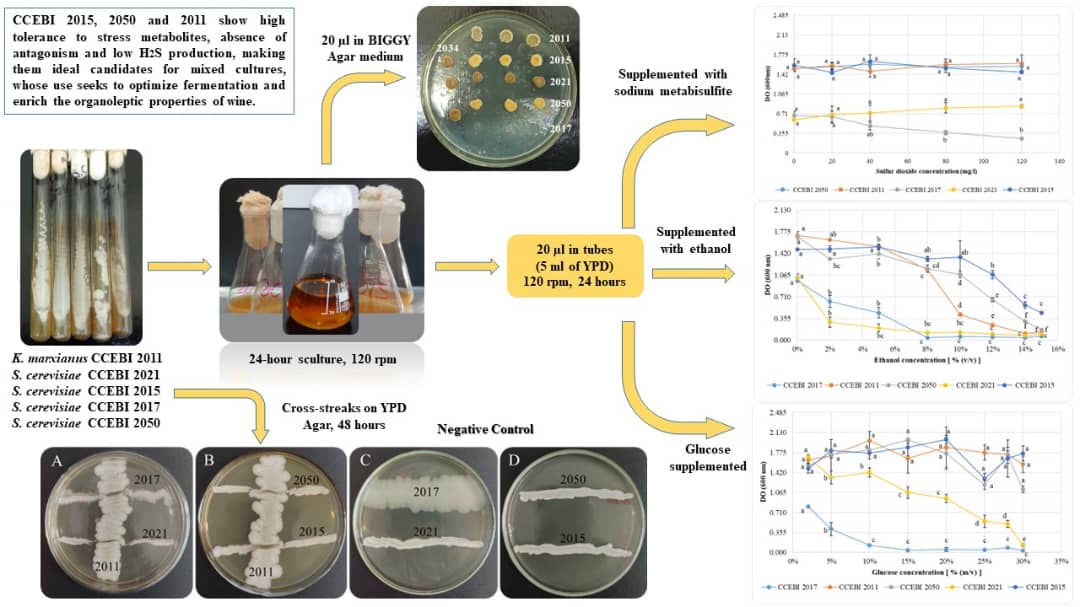
La fermentación del vino es un proceso complejo en el que intervienen diversas especies de levadura. La especie Saccharomyces cerevisiae destaca por su eficiencia fermentativa y las levaduras no-Saccharomyces, por su contribución a la complejidad aromática de los vinos. Este estudio tuvo como objetivo caracterizar cinco cepas (cuatro S. cerevisiae y una Kluyveromyces marxianus), procedentes de diferentes fuentes de aislamiento, en cuanto a características de interés enológico. Los resultados mostraron que las cepas CCEBI 2015 y CCEBI 2050 de la especie S. cerevisiae y K. marxianus CCEBI 2011 toleran altas concentraciones de glucosa (30 % w/v), etanol (10 % v/v) y SO₂ (120 mg/L) y presentan baja o nula producción de H2S. No se observó antagonismo entre K. marxianus y las cepas de S. cerevisiae. Estos resultados avalan el empleo de estas cepas como candidatas prometedoras, para su uso en cultivos iniciadores mixtos para vinificación.
Referências
FAZIO, N. A. et al. “Inside current winemaking challenges: Exploiting the potential of conventional and unconventional yeasts”. Microorganisms. 2023, 11(5), 1338. https://doi.org/10.3390/microorganisms11051338
COMITINI, F. et al. “Yeast interactions and molecular mechanisms in wine fermentation: a comprehensive review”. Int. J. Mol. Sci. 2021, 22(14), 7754. https://doi.org/10.3390/ijms22147754
ROMANO, P.; MAURIZIO, C.; GRAHAM, H. F. (eds.) Yeasts in the Production of Wine. New York, NY, USA: Springer. 2019, pp. 515. ISBN: 978-1-4939-9782-4. https://doi.org/10.1007/978-1-4939-9782-4
GERŐCS, A. et al. “Characterization of Saccharomyces strains isolated from “Kéknyelű” grape must and their potential for wine production”. Fermentation. 2022, 8(8), 416. https://doi.org/10.3390/fermentation8080416
BARONE, E. et al. “Use of Kluyveromyces marxianus to increase free monoterpenes and aliphatic esters in white wines”. Fermentation. 2021, 7(2), 79. https://doi.org/10.3390/fermentation7020079
VALLEJO-VIDAL, J. A. et al. “A novel Kluyveromyces marxianus strain with an inducible flocculation phenotype”. AMB Express. 2012, 2(38). DOI: https://doi.org/10.1186/2191-0855-2-38
SERRAT-DÍAZ, M. et al. “Influencia de las condiciones de cultivo sobre el crecimiento y contenido de pared celular en una cepa floculante de Kluyveromyces marxianus”. Revista Cubana de Química. 2017, 29(1), 89-102. http://scielo.sld.cu/pdf/ind/v29n1/ind07117.pdf
BILAL, M. et al. “Bioprospecting Kluyveromyces marxianus as a robust host for industrial biotechnology”. Frontiers in Bioengineering and Biotechnology. 2022, 10, 851768. DOI: https://doi.org/10.3389/fbioe.2022.851768
ERASMUS, B.; DIVOL, B. “Exploring the phenotypic diversity of oenological traits in Kluyveromyces marxianus strains”. FEMS Yeast Research. 2022, 22(1), foac009. https://doi.org/10.1093/femsyr/foac009
RUIZ, J. et al. “Occurrence and enological properties of two new non-conventional yeasts (Nakazawaea ishiwadae and Lodderomyces elongisporus) in wine fermentations”. International Journal of Food Microbiology. 2019, 305, 108255. DOI:
https://doi.org/10.1016/J.IJFOODMICRO.2019.108255
ESCRIBANO-VIANA, R. et al. “Selection process of a mixed inoculum of non-Saccharomyces yeasts isolated in the DO Ca. Rioja”. Fermentation. 2021, 7(3), 148. https://doi.org/10.3390/fermentation7030148
CORDENTE, A. G. et al. “Isolation of sulfite reductase variants of a commercial wine yeast with significantly reduced hydrogen sulfide production”. FEMS Yeast Research. 2009, 9(3), 446-459. https://doi.org/10.1111/j.1567-1364.2009.00489.x
LERTCANAWANICHAKUL, M.; SAWANGNOP, S. A “Comparison of two methods used for measuring the antagonistic activity of Bacillus species”. Walailak Journal of Science and Technology. 2008, 5(2):161-167. https://wjst.wu.ac.th/index.php/wjst/article/view/86
D'AMATO, D. et al. “Effects of temperature, ammonium and glucose concentrations on yeast growth in a model wine system”. Int. J. Food Sci. Tech. 2006, 41, 1152-1157. DOI: https://doi.org/10.1111/j.1365-2621.2005.01128.x
LAPPE-OLIVERAS, P. et al. “Genotypic and phenotypic diversity of Kluyveromyces marxianus isolates obtained from the elaboration process of two traditional mexican alcoholic beverages derived from Agave: Pulque and Henequen (Agave fourcroydes) Mezcal”. Journal of Fungi. 2023, 9(8), 795. https://doi.org/10.3390/jof9080795
FERREIRA, J.; TOIT, M. D.; TOIT, W. D. “The effects of copper and high sugar concentrations on growth, fermentation efficiency and volatile acidity production of different commercial wine yeast strains”. Australian Journal of Grape and Wine Research. 2006, 12(1), 50-56. Doi: https://doi.org/10.1111/j.1755-0238.2006.tb00043.x
SIPICZKI, M. “Yeast two- and three-species hybrids and high-sugar fermentation”. Microbial Biotechnology. 2019, 12(6), 1101-1108. https://doi.org/10.1111/1751-7915.13390
YOSHIDA, M. et al. “Wine yeast cells acquire resistance to severe ethanol stress and suppress insoluble protein accumulation during alcoholic fermentation”. Microbiology Spectrum. 2022, 10(5), e00901-22. https://doi.org/10.1128/spectrum.00901-22
MA, M.; LIU, Z. L. “Mechanisms of ethanol tolerance in Saccharomyces cerevisiae”. Applied Microbiology and Biotechnology. 2010, 87, 829-845. https://doi.org/10.1007/s00253-010-2594-3
MARULLO, P. et al. “Natural allelic variations of Saccharomyces cerevisiae impact stuck fermentation due to the combined effect of ethanol and temperature; a QTL-mapping study”. BMC genomics. 2019, 20, 1-17. https://doi.org/10.1186/s12864-019-5959-8
LAIRÓN-PERIS, M. et al. “Lipid composition analysis reveals mechanisms of ethanol tolerance in the model yeast Saccharomyces cerevisiae”. Applied and Environmental Microbiology. 2021, 87(12), e00440-21. https://doi.org/10.1128/AEM.00440-21
FENG, L. et al. “Selection of indigenous Saccharomyces cerevisiae strains for winemaking in Northwest China”. American Journal of Enology and Viticulture. 2019, 70(2), 115-126. DOI: https://doi.org/10.5344/ajev.2018.18035
CAMACHO-POZO, M. I. et al. “Evaluation of two conservation methods for Kluyveromyces marxianus CCEBI 2011 at the CEBI Culture Collection”. Revista de la Sociedad Venezolana de Microbiología. 2014, 34, 91-96. https://ve.scielo.org/pdf/rsvm/v34n2/art09.pdf
KARIM, A.; GERLIANI, N.; AÏDER, M. “Kluyveromyces marxianus: An emerging yeast cell factory for applications in food and biotechnology”. International Journal of Food Microbiology. 2020, 333, 108818. https://doi.org/10.1016/j.ijfoodmicro.2020.108818
ZARA, G.; NARDI, T. “Yeast metabolism and its exploitation in emerging winemaking trends: From sulfite tolerance to sulfite reduction”. Fermentation. 2021, 7, 57. https://doi.org/10.3390/fermentation7020057
MOLINA-ESPEJA, P. “Next generation winemakers: Genetic engineering in Saccharomyces cerevisiae for trendy challenges”. Bioengineering. 2020, 7(4), 128. https://doi.org/10.3390/bioengineering7040128
DIVOL, B.; DU TOIT, M.; DUCKITT, E. “Surviving in the presence of sulphur dioxide: Strategies developed by wine yeasts”. Appl. Microbiol. Biotechnol. 2012, 95, 601-613. https://doi.org/10.1007/s00253-012-4186-x
DE GUIDI, I. et al. “Development of a new assay for measuring H2S production during alcoholic fermentation: Application to the evaluation of the main factors impacting H2S production by three Saccharomyces cerevisiae wine strains”. Fermentation. 2021, 7(4), 213. https://doi.org/10.3390/fermentation7040213
LI, Y. et al. “Saccharomyces cerevisiae isolates with extreme hydrogen sulfide production showed different oxidative stress resistances responses during wine fermentation by RNA sequencing analysis”. Food Microbiology. 2019, 79, 147-155. https://doi.org/10.1016/j.fm.2018.10.021
ALTURKI, S. N. et al. “Killer phenomenon in yeast: An overview”. Journal of American Science. 2019, 15(4). Doi:
Downloads
Publicado
Como Citar
Edição
Seção
Licença
Copyright (c) 2025 Rolando Carrazana-Isaac, Manuel de J. Serrat-Díaz

Este trabalho está licenciado sob uma licença Creative Commons Attribution-NonCommercial-NoDerivatives 4.0 International License.
Esta revista oferece acesso aberto imediato ao seu conteúdo, com base no princípio de que oferecer ao público o acesso gratuito à pesquisa contribui para uma maior troca global de conhecimento.